What a Leasing Chatbot Should (and Shouldn't) Handle for Your Apartment Community
A leasing chatbot can field the same dozen questions your team answers all day, at midnight and on weekends — but only if you're honest about what it can't do.
A prospect finds your apartment community's website at 9:40 on a Saturday night, three days before the lease is up on their current place. They want to know if you take dogs over 40 pounds, whether the two-bedroom on the third floor is still open, and what the security deposit costs before they burn a Monday morning calling around town. Nobody is in the leasing office. By Monday, they've toured two other properties and forgotten yours existed.
That gap — between when a prospect wants an answer and when your team can give one — is the whole argument for a leasing chatbot. Not because it converts better than a person on the phone, but because for most of these questions, a live person was never actually necessary. Pet policy, parking, deposits, floor plans, what's open this week, what the application needs, office hours — none of that requires judgment. It requires an answer already written down somewhere on your site or a policy PDF, delivered the moment someone's asking instead of two business days later. This is about what a leasing chatbot can honestly do for a multifamily property, what it can't, and the two things vendors gloss over: availability drift and fair housing exposure.
What a leasing chatbot actually does on your website
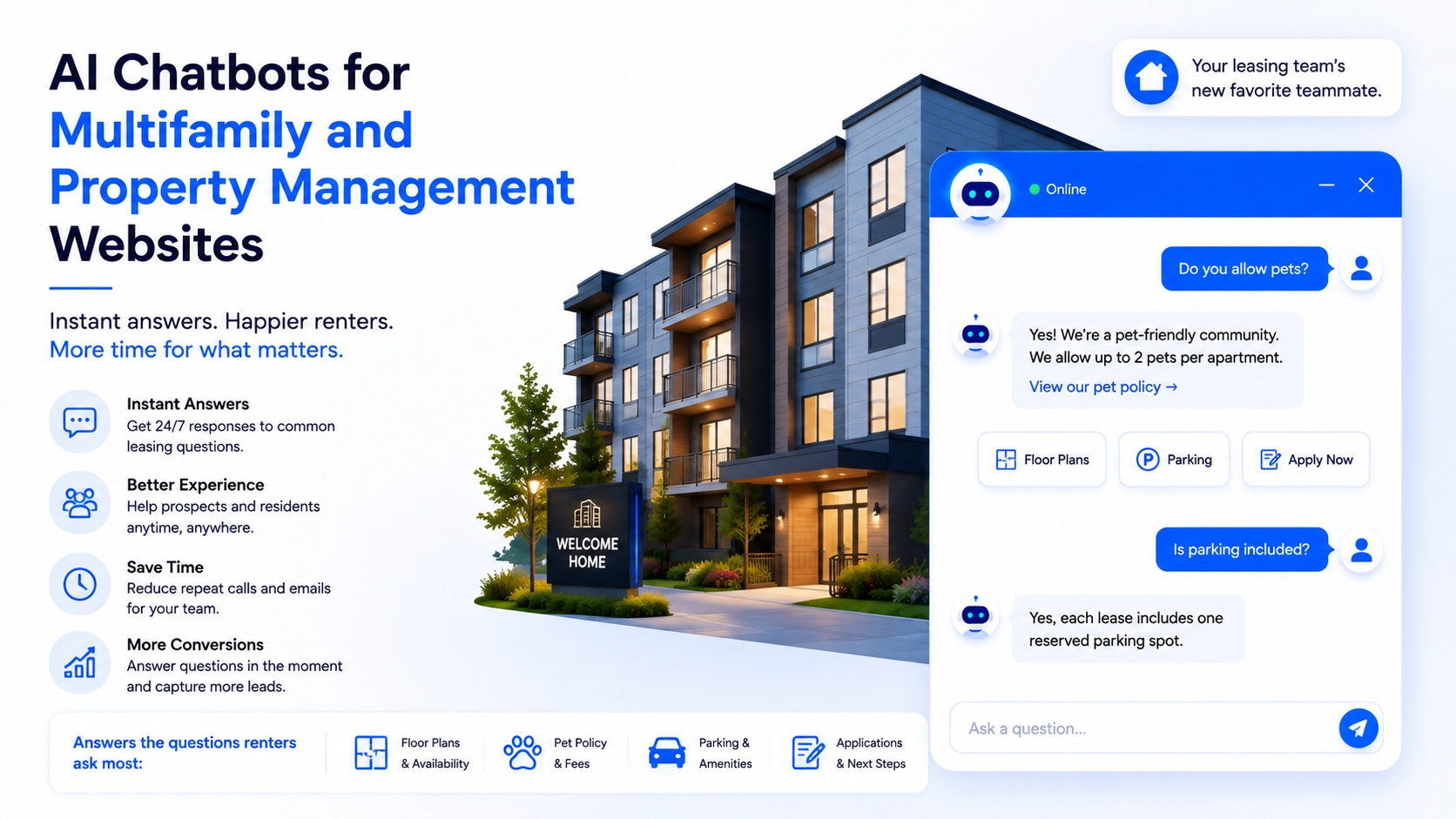
Strip away the marketing language and a leasing chatbot is a chat widget trained on content you already have: property pages, a PDF pet policy, a rent sheet, an FAQ page, and whatever your site's own crawl picks up. A prospect asks a question in plain language, the chatbot searches that content, and answers with a citation back to the source. You embed it with one script tag on any site — no plugin, no app.
Vendors call this an AI leasing assistant, which is fair as long as "assistant" isn't read as "replacement." An apartment chatbot doesn't connect to your property management system — it doesn't pull live unit data from Yardi, RealPage, Entrata, or AppFolio, and it doesn't create maintenance tickets or process an application. What it does well: represent your published content accurately, capture a prospect's contact details and intent as a lead, and route to a person when the question needs one. If you train it on your own floor plans, policies, and FAQ pages, it only ever repeats what you already decided to say publicly — the constraint you want on anything answering leasing questions unsupervised.
The questions it can genuinely answer from your own content
The realistic job for apartment chatbot software is the repetitive middle of the funnel — questions your leasing team answers by rote, dozens of times a week, regardless of who's asking:
- Pet policy: breed and weight limits, pet rent, deposits, number allowed
- Parking: covered vs. uncovered, guest parking, monthly cost
- Deposits and move-in costs: standard amount, application fee, admin fee
- Floor plans and square footage: layouts, bed/bath counts, which plans exist
- Application requirements: income multiple, documents needed, screening steps
- Office hours, address, and how to reach the leasing team directly
- Lease terms, utilities included, and amenity access
This matters more than it did five years ago, because so much of the shopping process now happens before anyone calls. In Zillow's 2024 Consumer Housing Trends Report, 74% of renters searched using a mobile website in 2023 (up from 65% in 2020), and 63% used an app (up from 51%). The same report found the typical recent renter now tours only one property in person, and roughly one-fifth didn't tour at all before signing — the share touring five or more has been cut in half since 2018. Prospects narrow their list online first; a leasing chatbot's job is making sure your property survives that narrowing with real answers ready at 11pm, not replacing the tour once someone's serious.
Where a multifamily leasing chatbot has to hand off to a person
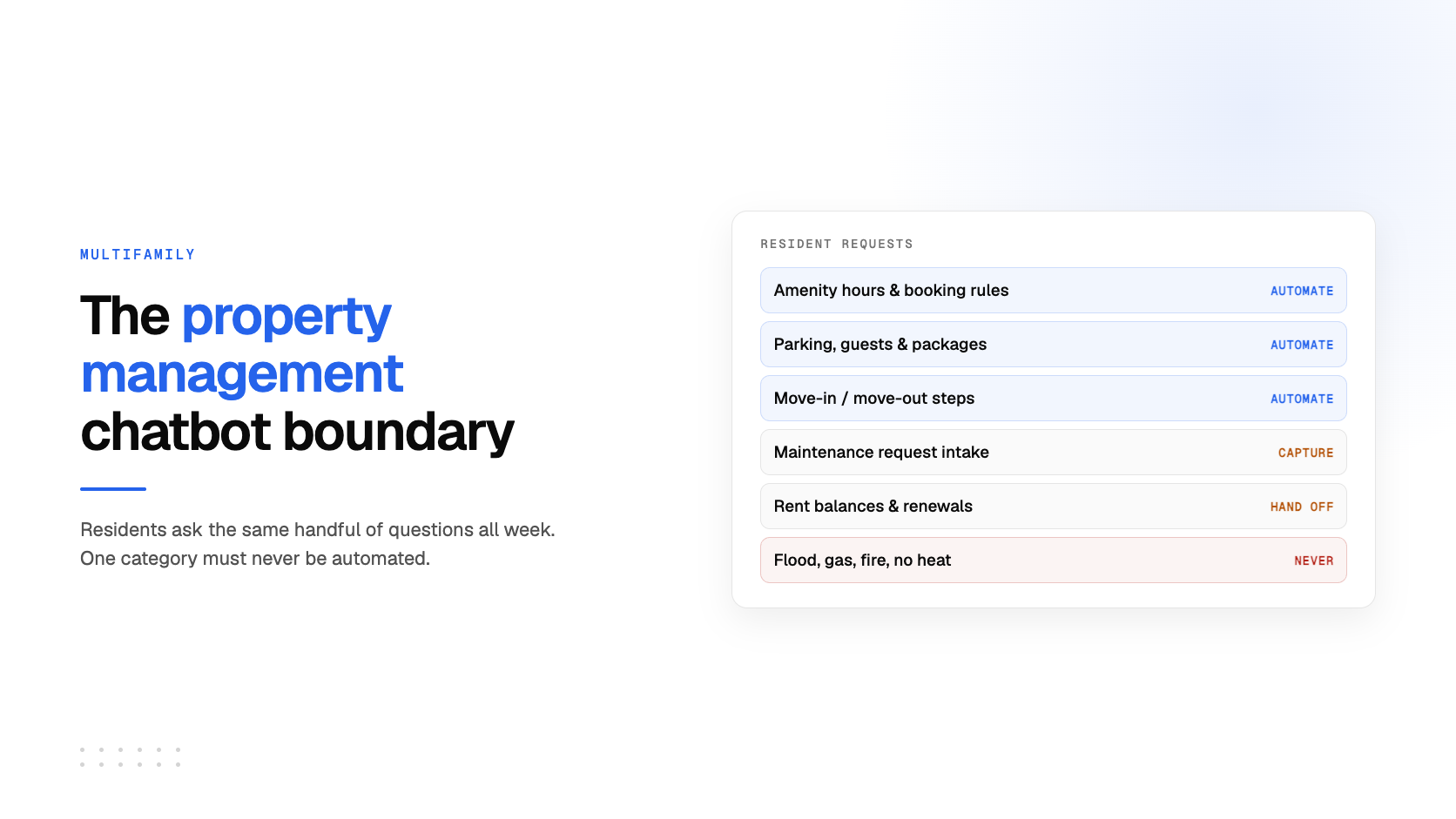
A multifamily leasing chatbot that pretends to have judgment it doesn't have will burn a prospect's trust in one exchange, and it won't take a sophisticated question to expose it: "Can you make an exception to the weight limit for my emotional support dog?" "Why was my application denied?" "I need an accessible unit — what's available?" Each needs a person, both because it requires judgment a written policy doesn't fully cover and because several brush against fair housing obligations, covered below.
Industry reporting reaches the same conclusion. The National Apartment Association's coverage of AI in leasing describes chatbots as a supplement to staff, not a stand-in — fast and available around the clock, especially useful outside business hours, but still routinely handed off to a person once a question gets specific. NAA's reporting on AI-powered virtual assistants in apartment communities frames the automation as freeing staff for tasks "that require expertise and personal attention," not eliminating the need for them.
Practically, your chatbot needs a real handoff path, not a dead end. A workable setup captures the enquiry as a lead — name, contact info, what they asked — and routes it by WhatsApp, email, phone, or a booking link, with the conversation history attached so nobody repeats themselves. A prospect who catches a chatbot bluffing about eligibility or price doesn't file a complaint; they tour somewhere else.
Keeping answers accurate when availability and pricing change
This is the part vendors skip, so it's worth being blunt: a chatbot trained on your website is only as current as your website. If a two-bedroom leases up Tuesday and the floor plan page isn't updated until Thursday, the chatbot will confidently tell a Wednesday prospect it's still open — not because the model is unreliable, but because the source document is stale. That's a content-operations problem, not something training away can fix. A few habits handle most of it:
- Don't ask the bot to memorize a moving target. For availability and exact pricing, use an action button to your live listings page instead of having the bot state a number from training content.
- Build in a standing caveat. Write "availability and pricing change frequently — our team will confirm current numbers" into the trained content so the bot repeats that line instead of guessing.
- Check what it's failing to answer. Review the unanswered-questions report weekly — the fastest way to spot stale or missing content.
- Resync on a schedule matching turnover. Fast-leasing properties need weekly refreshes; stable communities can run monthly.
Every answer also carries a citation back to its source, so a prospect or your own team can confirm it against the live page rather than take the bot's word for it.
Fair housing: keep a human in the loop
Leasing communication in the United States is governed by the Fair Housing Act, and that doesn't change because a chatbot wrote the message instead of a person. HUD issued guidance in 2024 on how the Act applies to AI-driven tools in housing, and as the National Apartment Association's coverage of that guidance lays out, responsibility for a fair, non-discriminatory process stays with the housing provider — not the software — whether that's a screening algorithm, a targeted ad, or a chat window.
We won't tell you what that means for your specific policies — that's a question for your own counsel, not a marketing article. As basic hygiene: don't let a chatbot make representations about eligibility, don't let it field accommodation requests (service animals, accessibility needs) without routing to a person, don't let it explain why an application was or wasn't approved, and don't let it improvise beyond policy language your team has reviewed. Have counsel review both the chatbot's trained content and its escalation rules before launch. To be direct about the product: EmbedMyBot carries no fair-housing compliance certification and isn't a substitute for legal review — what your chatbot says, and when it steps back, is your responsibility.
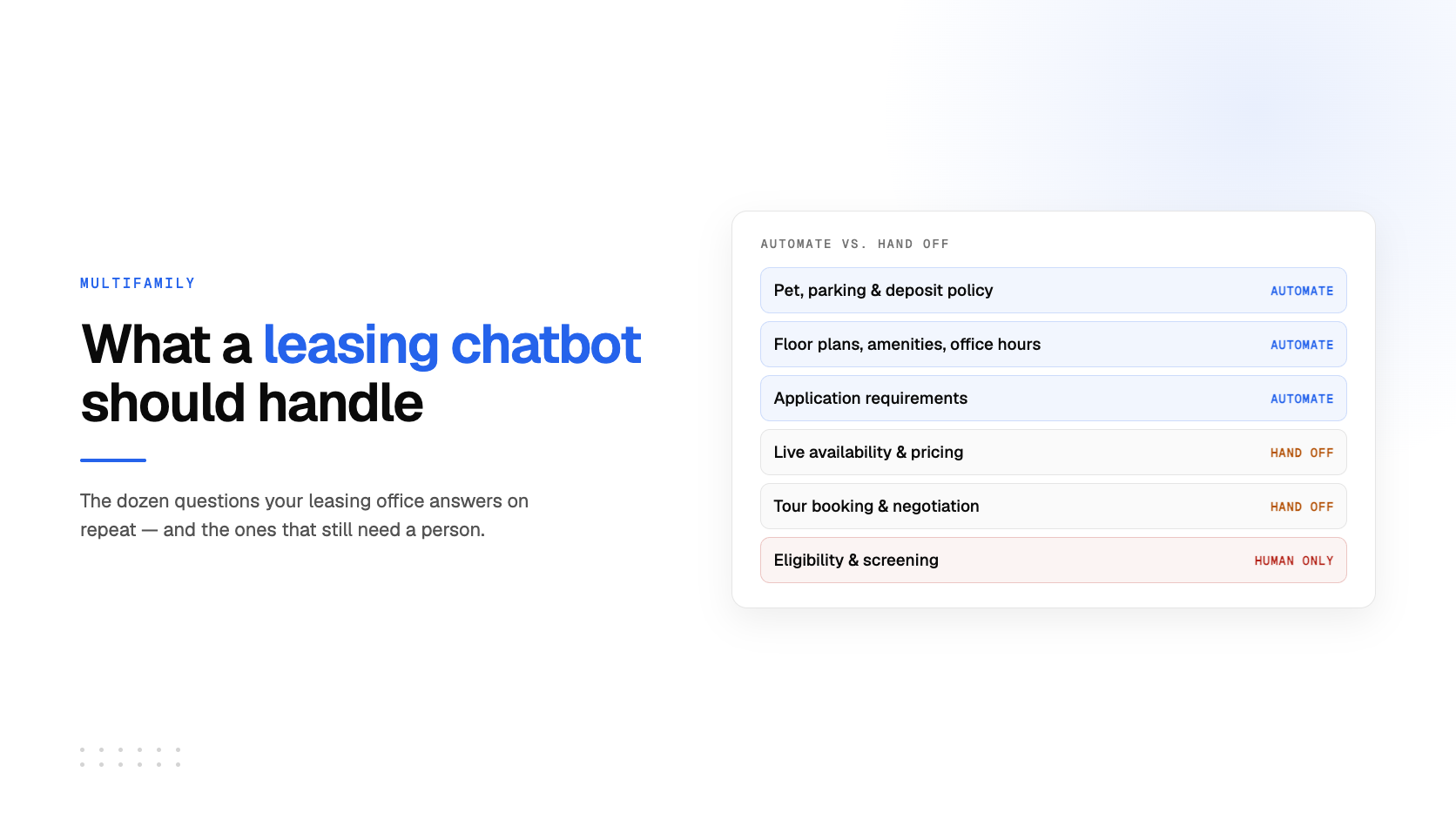
What to automate vs. what to route to a human
| Topic | Safe for the chatbot | Route to a person |
|---|---|---|
| Pet policy (breed, weight, fees) | General policy from your written rules | Service or emotional support animal accommodation requests |
| Parking | Cost, type, guest policy | Requests for extra or reserved spots as an exception |
| Deposits & move-in costs | Standard published amounts | Requests to waive or reduce a fee |
| Floor plans | Layouts, square footage, which plans exist | — |
| Availability & pricing | Pointing to your live listings page | Confirming an exact current price or move-in date |
| Application requirements | General checklist (income, ID, docs) | "Will I qualify?" or screening-outcome questions |
| Accessibility needs | — | Always a person |
| Office hours & contact info | Yes | — |
| Tour requests | Capture preferred times, link to booking page | Confirming the actual appointment |
| Application status or denial reasons | — | Always a person |
Getting a leasing chatbot live without overpromising
Setup is quick: upload your pet policy, rent sheet, and FAQ documents as PDFs or pasted text, let it crawl your site for floor plans and amenities, and turn on lead capture. Set a real handoff channel — WhatsApp, email, phone, or a booking link — and add an action button to your live listings page rather than letting the bot promise a number it can't verify. Check the analytics weekly: busiest hours show when after-hours coverage is earning its keep, and unanswered questions show what to add next.
If you manage more than one community, see how other real estate teams structure their chatbots first — a boutique property and a portfolio with a dozen leasing offices need different setups. Start on a free plan if testing on one property; within a week or two, the questions it fails to answer will tell you what it still needs.
Frequently Asked Questions
What is a leasing chatbot?
A leasing chatbot is a chat widget on an apartment community's website that answers prospect questions — pet policy, parking, floor plans, deposits, office hours — using content uploaded or crawled from the site, and captures contact details as a lead. It supplements the leasing office; it doesn't replace judgment calls only a person can make.
What's the difference between a leasing chatbot and an AI leasing assistant?
Same tool, two angles: the chat window a prospect sees, and the role it plays for your team. Neither term implies it can process applications, verify eligibility, or sync live with your property management system — those still require a person and, usually, dedicated software your PMS vendor provides separately.
Can an apartment chatbot book tours automatically?
Not on its own, unless connected to a separate scheduling tool. It can capture a prospect's preferred times and contact information as a lead, or use an action button to send them to your existing booking page, so your team confirms the appointment instead of the bot inventing availability it can't verify.
How do I keep chatbot answers accurate as units lease up?
Treat pricing and availability as something the bot points to, not memorizes. Link to your live listings page for the current number, keep a standing caveat in the training content noting figures are subject to confirmation, and resync source documents on a schedule matching turnover — weekly for high-turnover communities.
Is it legal to use an AI chatbot for apartment leasing?
Answering general questions with a chatbot is common practice, but leasing communication is governed by the Fair Housing Act, and HUD's 2024 guidance makes clear responsibility for a fair process stays with the operator, not the software. Route anything touching eligibility, screening, or accommodation requests to a person, and have counsel review your chatbot's content and escalation rules.
What does apartment chatbot software cost?
Pricing varies by vendor and how many chatbots and messages you need. EmbedMyBot's free plan covers one chatbot and 50 messages a month with no credit card; paid plans start at $5/month billed monthly, or $4/month billed yearly, with more chatbots and features at higher tiers. See pricing for current details.